Thursday, February 25, 2016

Ms. Hen reviews DRIVING MR. ALBERT: A TRIP ACROSS AMERICA WITH EINSTEIN'S BRAIN


DRIVING MR. ALBERT: A TRIP ACROSS AMERICA WITH EINSTEIN’S BRAIN
By Michael Paterniti
2000
Random House


Ms. Hen picked this book up by accident because she found it in her house. Sometimes books are left in her house by some chicken or other who has lived there at one time. She was intrigued by the title, and when she found out it is a nonfiction book about driving Albert Einstein’s brain across America, she decided she was interested.

There was something about this book that seems strange to Ms. Hen. The narrator, the man who was driving, first heard about Albert Einstein’s brain in jars in somebody’s house in Kansas, and he became fascinated with it. Unduly fascinated. It was like he was obsessed, but there was no explanation for it.

Michael Paterniti offered to drive Doctor Thomas Harvey, the man who did the autopsy on Albert Einstein, across the country to deliver the brain to Einstein’s granddaughter Evelyn in San Francisco. Paterniti did a lot of research about Einstein before the drive, including trips to England and Japan to interview people obsessed with Einstein and his brain.

The two men travelled across the country together, stopping at various people’s houses and landmarks along the way. Dr. Harvey kept Einstein’s brain in a Tupperware container in the trunk. Paterniti took to telling people they met that they had Einstein’s brain. The reactions from different people varied: at one hotel, the clerk became violently angry about Einstein and the fact that he was considered a genius, and in Las Vegas, a waitress had him kicked out of the casino because she thought he was harassing her when he told her of Einstein’s brain.

This book is not just about the drive across the country; it is also partly a biography of Albert Einstein. When Einstein published the general theory of relativity, he became a worldwide celebrity. Dr. Harvey was supposed to do research to find out if Einstein’s brain was different from a normal brain, but he essentially stole it from the autopsy room, and a lot of scientists could not forgive him for the fact that he pilfered what could be one of the greatest brains in the history of the world.

The writing in this book is excellent. The prose sings. That combined with the fact that the subject is so interesting made this for a quick read. Ms. Hen was drawn into the world of Albert Einstein and the fascination with his brain. Ms. Hen does not know if she would be as excited to be close to Albert Einstein’s brain as some people, but she loved reading about those who were.

When Paterniti first sees the brain in glass jars that Dr. Harvey holds in his hand, he describes it this way, “one at a time pulled out two large glass cookie jars of what looked like chunks of chicken in a golden broth: Einstein’s brain chopped in pieces in sizes that ranged from a turkey neck to a dime.” Ms. Hen likes that Einstein’s brain looks like chunks of chicken. Of course it looks like chicken. What else would it look like? Chickens could be secret geniuses. Perhaps Einstein was really a chicken deep down inside. Perhaps we are all chickens in some Universe, or that’s what we become, in some space-time, as Einstein describes.


This is not the typical book that Ms. Hen reads, but she likes to branch out and try something new once in a while, and she’s glad she did. She has never imagined what it would be like to see Einstein’s brain before reading this, or any brain for that matter, but she can understand the fascination of being close to something perverse and amazing at the same time. Ms. Hen is not perverse and amazing, but she likes to think that she possibly could be one day; she wants to try to strive to have a brain as intelligent as Einstein’s: that is Ms. Hen’s new goal.

Friday, February 19, 2016

Ms. Hen reviews SPUTNIK SWEETHEART


SPUTNIK SWEETHEART
Haruki Murakami
Translated from the Japanese by Philip Gabriel
Alfred A. Knopf, New York
2001

Ms. Hen is a big fan of Haruki Murakami. She has read several of his books, including THE WIND UP BIRD CHRONICLES, A WILD SHEEP CHASE, 1Q84, and NORWEGIAN WOOD, and has loved them all. She, and many people, think that there is a Murakami style, certain elements that make up his books, and it has been said that when a person is reading Murakami, it makes that person view the world in a different way. SPUTNIK SWEETHEART has all these elements, and it did not disappoint Ms. Hen.

SPUTNIK SWEETHEART is a love story, a mystery, and a story of magic all in one. It is told through the eyes of a young man who is in love with his friend Sumire, but she doesn’t love him romantically. She dreams of becoming a writer, and she spends all her time writing. She falls in love with a much older woman, to the surprise of the narrator, and she travels with the woman to Europe where she disappears from a Greek island.

The elements are all here for the Murakami novel: a missing person, mention of wells and cats, unrequited love. The only different aspects are the fact that Sumire wants to be a writer, and the lesbian part, but that is thrown in because it seems necessary.

When Ms. Hen read this, she longed to go to the Greek island. She felt as if she were there, and she could feel the sand beneath her toes and see the blue sea. She felt for the narrator, who went to the beautiful place, but was too bothered by the fact that Sumire was missing to enjoy that he was in a such a place. Sometimes beauty is not enough, when we’re faced with heartache and loss, as Ms. Hen knows.

There are two places in SPUTNIK SWEETHEART where roosters are mentioned, both about the place where Sumire lives. She calls the narrator and she tells him, “ ‘Right near where I live there’s a man who raises roosters. Must have had them for years and years. In a half hour or so they’ll be crowing up a storm. This is my favorite time of day. The pitch–black night sky starting to flow in the east, the roosters crowing for all they’re worth like it’s their revenge on somebody. Any roosters near you?’ “ She moves out of that apartment shortly after that, where there are no roosters.


There are no words to explain how good this book is, and Murakami is an exceptional writer, one that can sweep the reader to a different world. At first Ms. Hen thought that this book was too good to review, and that everyone knows Murakami is amazing, but she isn’t sure about this. She wants to spread the word that people should read books by Murakami because his books make the world a better place. To be transported is the purpose of literature, and Murakami accomplishes that in everything Ms. Hen has read by him. So run out and get his books, Ms. Hen says, while dreaming of a blue sea in Greece, with snow coming down outside her window. She’s inside drinking coffee, considering the probability of magic.


Thursday, February 11, 2016

Ms. Hen reviews MOTHERS AND SONS


MOTHERS AND SONS
Colm Toibin
Scribner
2007

Ms. Hen read this book because she is interested in Ireland. She is not a mother or a son, and she most likely never will be, but she wanted to try to understand human relationships. She discovered that this isn’t simply a collection of short stories about mothers and sons; they are stories about how hard life can be at times, and how everything can seem like it won't get any darker, but it does.

The word that came to Ms. Hen’s mind to describe these stories is visceral. There are moments in each of the stories when she could see or smell the things that make up life itself, that it’s not just writing, she felt as if she was living these characters’ lives.

In the story “The Name of the Game,” Nancy opens a chip shop in order to pay off her debts and help get away from the small town where she feels trapped. Her son thinks the business is permanent and he will inherit it one day, but she dreams of moving to Dublin. The shop, which is above their home, makes their home smell like cooking oil, “But despite the money, nothing could be done about the smell of cooking oil, right up to their bedrooms.” Ms. Hen could smell the fish and chips in their house. She’s never been covered with the smell of fish and chips, but she can imagine how horrible it could be. Nancy’s young daughters are mortified when the children at school mock them.

The story, “Three Friends,” is about the death of Fergus’ mother. His three friends take him to a rave on the beach shortly after she dies where they drink and take a variety of drugs. Fergus doesn’t want to think about his mother’s death, and his friend Mick makes advances toward Fergus while they are swimming the next morning. Fergus is high and confused, but he enjoys what happens. Ms. Hen understands that people do outrageous things when they are grieving, when combined with drugs. Ms. Hen isn’t sure if Fergus would do such a thing if he wasn’t in grief, but she doesn’t know. From reading the stories in this collection Ms. Hen grasps that life can be unpredictable sometimes.

The collection concludes with the story, “A Long Winter,” which is set in Spain, the only one not that does not take place in Ireland. It is about a family of farmers: a mother, a father, and two sons Miquel, and Jordi, who is about leave to join the military. The father and Miquel discover that the mother has started drinking, and they try to stop her. The mother becomes upset, and leaves the house. The men try to find her. When Ms. Hen read this story, she could imagine the place where these people live: a rural village in northern Spain where it snows and the neighbors hate each other, where people do their best to exist day to day, but they don’t always succeed.

Ms. Hen thought this might be a book that did not have any hens, but she was pleasantly surprised that the last story contains some rather important ones. On the farm, the mother cooked and took care of the rabbits and hens. After the mother disappeared the hens didn’t like it, “Slowly the hens began to lay fewer eggs and the rabbits began to die.” The mother disappeared and the hens didn’t like the way Miquel took care of them, and they revolted in their own way.  


Ms. Hen loved this book. It’s special in the way that it shows the reader other parts of the world, and how people are different everywhere, but yet are the same. Everyone just wants to be happy and survive, as displayed by the stories in this collection. Ms. Hen gives MOTHERS AND SONS five feathers up.

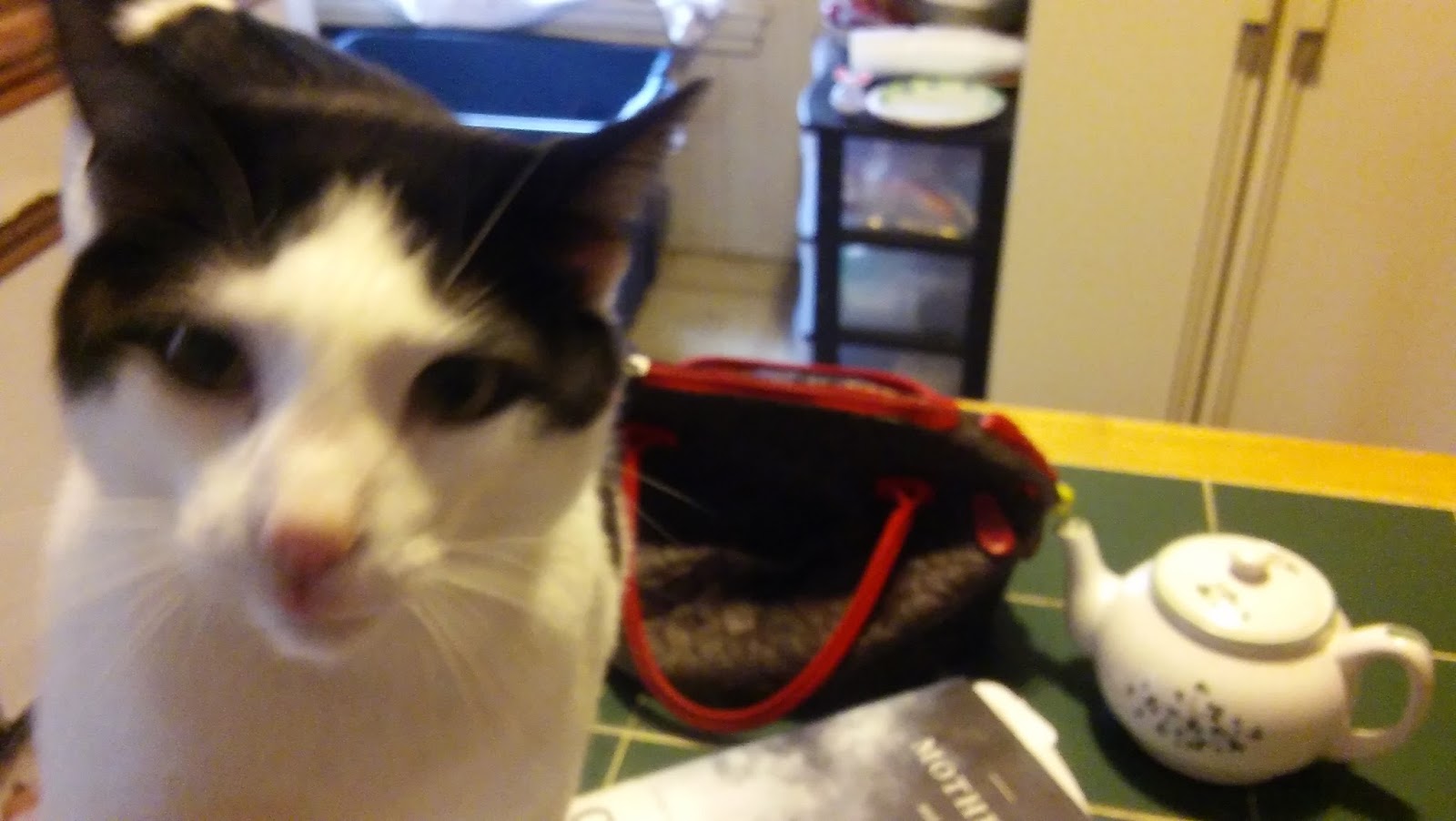
Mikki Mikao photobombs the picture

Friday, February 5, 2016

Ms. Hen reviews Z


Z: A NOVEL OF ZELDA FITZGERALD
Therese Anne Fowler
St. Martin’s Press, New York
2013

Ms. Hen decided to read this novel because she enjoys fiction about mental illness, and also about writers. Z is about Zelda Fitzgerald, F. Scott Fitzgerald’s wife. He was famous for writing THE GREAT GATSBY, as well as many other books. She was a southern debutante, whose heart was stolen by Scott when he was a lieutenant in the Army stationed near her home in Montgomery, Alabama.

There are different ideas about Scott and Zelda’s relationship. Some people say she prohibited him from doing his work, but some say the opposite about him. Zelda was a wild young woman who got whisked away to New York. She didn’t agree to marry Scott until his book was about to be published, because she didn’t want to have to work, because no respectable married woman would ever have to work, as she was taught from a very young age. But she changed her mind as she learned more about the world.

Scott and Zelda lead a life of debauchery in New York, Paris, the Riviera and Hollywood. They were known as The Jazz Age couple. He wrote novels about flappers, and they life he and Zelda lived. He drinks himself into a stupor most every night, but somehow he manages to write. They rub elbows with all the important people in Paris: Picasso, Cole Porter, Gertrude Stein and the young up-and-coming writer Ernest Hemmingway. Zelda begins to hate Ernest because she thought he considered himself too much of a manly man. That, and an incident between the two of them outside a bar in Paris. She doesn’t want her husband to be like Hemmingway; she thought Scott was too sensitive to be like his friend.

Z is written in the voice of a southern lady. At first, Ms. Hen found it hard to get into, but she got used to it after a while. She was reminded of books by F. Scott Fitzgerald in which all the characters behave badly and have no regard for money, the future, or anyone beside themselves. Ms. Hen found it difficult to love this novel because most of the characters are highly unlikeable. The novel is written well, and the plot is well executed, but she found that she would not like to have a cup of coffee with any of the characters because she would want to punch them in the face. But that is her opinion.

The most disturbing part of this novel is when Zelda is in the psychiatric hospital in Switzerland. She is sent there because she has a breakdown since she spent all her time training to be a ballet dancer. The doctors try to reprogram her and force her to admit that a woman’s place is taking care of her husband and her children and if she dreams of a career outside of the home, it will only cause her agony and illness.

Ms. Hen is disgusted by this treatment of Zelda. She knew that the world was a different place in years past, but to force women to transform their thinking in this way is despicable. She knows that a lot of people glamorize the 1920s and the past, but Ms. Hen would never want to live in the past! Just because the people seemed like they had fun, and went to wild parties and wore beautiful clothes, it doesn’t mean that the world was a wonderful place. It was a terrible place.


Ms. Hen liked Z, but she didn’t love it. She felt sorry for the characters, and she’s glad she doesn’t have to live their lives. F. Scott Fitzgerald died at the age of 44, practically penniless. Zelda lived for many years after that, and struggled financially for most of that time. F. Scott Fitzgerald has become one of the great American novelists of all time. Ms. Hen gives Z four feathers up.

Tuesday, February 2, 2016

Ms. Hen reviews WHERE'D YOU GO BERNADETTE?


WHERE’D YOU GO, BERNADETTE?
Maria Semple
Little, Brown and Company
2012


Ms. Hen chose to read this book because it is about a woman with anxiety, and there aren’t many novels on this subject.  Ms. Hen likes reading books about mental illness because she usually learns something new. Ms. Hen has been reading some fantastic books since the beginning of the new year, but sadly, this book was an exception.

WHERE’D YOU GO BERNADETTE is a plot-driven novel. It is meant to capture the reader’s attention so she’ll finish it quickly. This book is written in a different format than most of these types of novels, however; it is written in the form of emails and messages between the characters. In between the emails and notices, the novel is told through the point of view of Bernadette’s fourteen-year old daughter, Bee.

The book starts with Bee telling her parents that she received perfect grades for her report card. Her parents had promised she could have anything she wanted if she got perfect grades all through school. Originally, she wanted a pony, but she changes her mind and wants the family to take a cruise to Antarctica. Her parents consider it and say yes.

Bernadette hires a personal assistant from India to take care of her affairs. She hates dealing with people in her everyday life. She hates her daughter’s classmates’ parents; she hates talking to people in stores. Bernadette, and almost all of the characters in WHERE’D YOU GO BERNADETTE are despicable people. It’s difficult to spend a lot of time reading a book in which most of the characters are horrible, ignorant and rude.

The reader discovers why Bernadette is like this: she is a failed architect. When she was younger, she was an up-and-coming architect in L.A., but she had a big disappointment and fled to Seattle with her husband. She detests everything about Seattle.

The one good aspect of this novel is the description of the cruise to Antarctica. Ms. Hen never had a desire to go to Antarctica, but after reading about riding a kayak through the ice at the bottom of the world, she decided this is something she would consider doing. Ms. Hen would love to see blue ice, and she can imagine herself as a hen in a kayak, waving at the penguins and floating through the icebergs.

Ms. Hen thought this novel was too sitcom-like, and it is no surprise that the author, Maria Semple, used to write for sitcoms such as MAD ABOUT YOU and ARRESTED DEVELOPMENT. Ms. Hen does not think a novel should be like a sitcom. She thinks a novel should be something elevated about the usual sitcom jargon. But that is one hen’s opinion.


Ms. Hen didn’t love this book. She didn’t enjoy reading a novel full of spiteful characters. Bernadette is a difficult person to spend time with, and the rest of this sorry lot isn’t much better. Ms. Hen gives WHERE’D YOU GO BERNADETTE? two and a half feathers up.

Friday, January 29, 2016

Ms. Hen reviews MISS EMILY


MISS EMILY
Nuala O’Connor
Penguin Books
2015

Ms. Hen decided to read this novel because the author has the same last name as she does, and also because she is entranced with Emily Dickinson. Many years ago, Ms. Hen visited Emily Dickinson’s Homestead in Amherst, Massachusetts, and she has always wondered what Miss Dickinson was really like, was she truly mad? Was she happy never leaving her house? And what made her so afraid of other people?

Ms. Hen knew that these questions would not be answered by reading this novel, because, the fact is, it is fiction. But this novel breathes life into Emily Dickinson. Ms. Hen always wondered what her writing methods were, and this novel describes the way Miss Dickinson wrote, and reading this made Ms. Hen imagine her better.

MISS EMILY brought to mind MARCH by Geraldine Brooks, a spinoff novel of Louisa May Alcott’s LITTLE WOMEN. Ms. Hen wondered when she read MARCH if Louisa May Alcott would approve of it, and Ms. Hen decided that Miss Alcott would have. Ms. Hen also tried to decide if Emily Dickinson would enjoy MISS EMILY, but Ms. Hen was not sure about that. Louisa May Alcott was a daring and brave woman, who would have embraced the raciness in MARCH, but poor Miss Emily never left her house, and Ms. Hen thinks there’s a possibility Miss Emily would die many times over if she read Nuala O’Connor’s novel. But Ms. Hen doesn’t know. Nobody knows what Emily Dickinson would think because not much is known about her.

Ms. Hen thought that MISS EMILY would be a sweet novel about friendship between Emily Dickinson and her Irish maid Ada Concannon. It started out that way. The new servant comes to the house, and Emily and Ada converse while they bake together in the kitchen. But somewhere in the middle, the novel turns dark. Ms. Hen was disgusted at what happens. But she found when she arrived at the shocking part, she couldn’t stop reading. A force overtook Ms. Hen and she plowed through the novel.

Even though there are disturbing parts, the writing in this novel is delightful and charming. It contains such an Irish lilt to it that Ms. Hen could hear Ada’s voice; she embraced the things Ada said because she felt they were part of her language, even though her family has lived in the United States for over one hundred years. As well as being about Emily Dickinson, this novel is also about the Irish experience in America in the nineteenth century. Ms. Hen is not used to such blatant prejudice in her country now, but those were different times.

There are a least ten places where hens or chickens are mentioned in MISS EMILY.  Ms. Hen thought this was appropriate since the novel took place in a rural area. Ms. Hen finds there are usually hens in novels about the country, because they are everywhere. One of Ms. Hen’s favorite quotes from MISS EMILY is, “Since Ada arrived, the hens have been laying again.” The father thinks she might be a sorceress, since she has bewitched Emily and facilitates the household smoothly.


Ms. Hen does not remember when she read a more charming, surprising and all-encompassing novel. She loved living in Emily Dickinson’s world for a short time. She felt like she got to know Miss Emily better than she had before. Ms. Hen gives MISS EMILY five feathers up, because how could she not.


Monday, January 25, 2016

Ms. Hen reviews THE DOORS OF PERCEPTION and HEAVEN AND HELL


THE DOORS OF PERCEPTION and HEAVEN AND HELL
Aldous Huxley
1954, 1956
Harper & Brothers

Ms. Hen decided to read this book because she read on Jim Morrison’s Wikipedia that the band The Doors got their name from the title. She had read BRAVE NEW WORLD many years ago, and she didn’t know much about Aldous Huxley, but she discovered he is a fascinating character who held a lot of radical ideas, some of which have been prophetic, such as the pervasiveness of technology into our society. The ball stared rolling with television, but it got much bigger.

Ms. Hen does not read much nonfiction, and she found her attention wandered while she was reading this. It reminded her of reading books of philosophy, which Ms. Hen does not like. But there were some interesting aspects of this book.

In THE DOORS OF PERCEPTION Huxley describes taking mescaline, and the effect it had on his mind. The colors he saw expanded, the shapes distorted and everything seemed to be bigger and brighter and more vivid. In HEAVEN AND HELL, Huxley describes throughout history what people have thought heaven was, whether it was jewels, or glass windows. Humanity strived for heaven.

In THE DOORS OF PERCEPTION Huxley explained that doing mescaline or peyote or any mind-expanding drug is similar to a schizophrenic experience. Schizophrenia, in the time he was writing, blanketed almost all mental illness because there wasn’t a word for other illnesses yet. Ms. Hen does not know why people would want to expand their minds, since she knows that some people take medication to keep from having their minds explode. Hallucination inducing drugs are fine for people who have never had their mind set free, but for Ms. Hen, she thinks that if some people did drugs, they might never come back to reality.

The writing in the book is excellent, the descriptions of the hallucinations are probably revolutionary, but Ms. Hen does not know for sure, because she has not read much about drugs or spirituality. Ms. Hen enjoyed HEAVEN AND HELL more than THE DOORS OF PERCEPTION, because it made her understand the history of the pursuit of heaven.


This small book opened Ms. Hen’s eyes to what people think of drugs and hallucinations. She had never thought someone could do drugs as part of an experiment, or simply to write about it. Ms. Hen admires this book, but it wasn’t exactly her cup of tea. She is not going to give any feathers to this book, because she doesn’t feel like it. She will not be doing any mind-expanding drugs as a result of this book. In fact, she will stay far away from them as best she can.